Friday December 19th, 2025
By Zia ur Rehman
The Second World Summit for Social Development 2025 (WSSD2) in Doha was disappointing, as it did not deliver the expected Copenhagen+30 outcomes.
A World in Crisis Without a Political Compass
The world is facing three major crises: the ongoing genocides, worsening climate disasters, and shrinking democratic spaces and fundamental freedoms across different regions. After COVID-19, when women, informal workers and marginalised groups were hit the hardest, the world should have learned that social protection is a basic right for all. Instead, we heard the same familiar excuses.
At the inaugural session of the Civil Society Forum at WSSD2, Roberto Bissio of Social Watch rightly noted, “The World Bank and IMF had to rename their Structural Adjustment Programmes as ‘austerity’ because these programmes caused massive damage to national budgets and public systems.”
In many countries today, public health systems have been weakened so badly that much of the damage cannot be repaired. At the same time, many governments have lost much of their political or economic autonomy. Instead of making their decisions independently, they are forced to negotiate with stronger international powers or financial institutions because they depend on external funding or have unstable political systems.
A Summit Without Political Presence
Influential political leaders failed to attend the WSSD2 or chose not to attend. There was a noticeable absence of the United States, which did not send a delegation. Most governments sent their entry-level officials to attend the conference. As compared to 173 Heads of States and Governments in the first World Summit for Social Development held in Copenhagen in 1995, Doha attracted only 40 Heads of States. The leaders of the world failed to bring adequate gravity to this critical moment. The most striking gap at the conference was the near-total absence of accountability measures. In fact, the word “accountability” appeared only once in the entire political document. This omission was not accidental. It reflects a broader global pattern in which a small number of influential actors use the label of “innovation” to consolidate their power while distancing themselves from any real scrutiny.
Civil Society Sidelined—and Slowly Losing Space
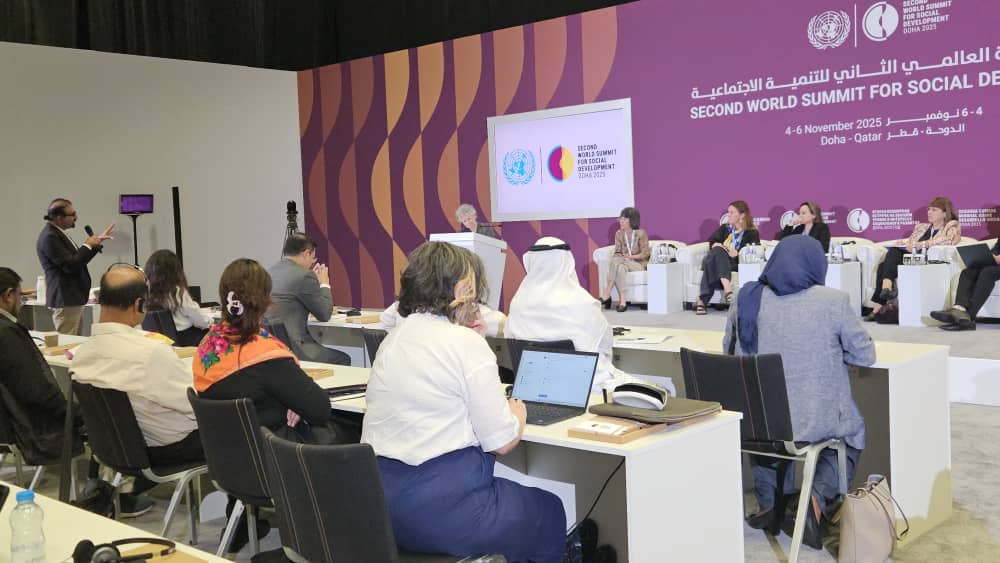
Civil society representatives attended the summit, but they were given no opportunity to shape its future direction. Unlike the SDG Summit in 2023 and Rio+20 process—both of which included structured and meaningful civil society participation—the Doha summit physically and procedurally separated governments from CSOs. Member States organised their “solution events” in dedicated halls, while civil society organisations were placed in separate, more distant areas, reinforcing the divide through different buildings, floors, and hall locations.
Very few civil society representatives at the roundtables were permitted to speak, despite the presence of hundreds of organisations. The situation felt both deliberate and symbolic.
The civil society was unable to demonstrate political effectiveness, largely due to the absence of major CSOs groups—who typically lead and energize civil society engagement. This was also because of the back-to-back global meetings during the year 2025. Three major events, including International Civil Society Week at Bangkok, WSSD2 at Doha and COP30 at Belem, were planned in the month of November 2025. As a result, CSO interventions devolved into self-referential speeches rather than substantive efforts to shape the agenda, making it impossible for them to meaningfully influence the process.
The main exhibition area was placed in a remote section of the venue, difficult for both government and non-government representatives to reach. Compounding this, the event lacked any coherent public outreach strategy, media engagement plan, or global communication effort. International media attention remained focused on Belém and preparations for COP, while major news outlets largely ignored Doha altogether.
The Shadow of Corporate Capture
The influence of large corporate organisations was apparent throughout the WSSD2 as they received opportunities to present at high-level meetings, yet their statements failed to create meaningful and transformative political change. In contrast, organisations working directly with communities including grassroots groups and feminist organisations as well as young activists faced difficulties in getting their voices heard.
Ultimately, the Doha process lacked substance because it failed to deliver the multilateral spirit. The world continues to operate under business-as-usual conditions despite only 18% of the SDGs being on track. The WSSD outcome document contained no meaningful representation from civil society organisations. The process excluded all individuals who possess firsthand knowledge about poverty and displacement and inequality in their communities.
Hope Is Too Dangerous to Lose
The level of discontent continues to increase. Unresolved frustration creates threats to social movements and democratic systems – even more so to the vulnerable populations who depend on weak social protection systems.
The situation demands our absolute commitment to progress because we cannot surrender. The Doha Declaration served as a critical alert to the world even though it lacked political success. Today, it stands as a vital document that civil society organisations should embrace as a central tool for advocacy and action.
The document serves as proof that governments have not fulfilled their Copenhagen commitments: showing the wide gap between their words and actual results.
Civil society organisations should seize this critical period to push governments to take the following essential actions:
- There is a dire need to establish robust accountability systems which will operate at both national and international levels.
- The social protection floor needs to provide complete coverage to all people while being specially designed to address the needs of women, children, marginalised communities and to withstand climate change effects.
- Public funding must be allocated and managed independently of austerity measures and corporate influence.
- The world needs to initiate a citizens-led multilateral system which serves people rather than powerful interests.
Civil society organisations need to determine their future direction after the WSSD2
The WSSD2 demonstrated that civil society networks require mandatory coordination to achieve their goals. The following elements are essential for our success:
Global and regional level civil society platforms need to create robust internal operational frameworks.
Advocacy event scheduling needs to be more strategic and effective. Funding should support not only employee travel but also grassroots outreach, research initiatives, and community-based activities.
The current loose coordination system needs to evolve into a unified strategic approach.
Global events like the WSSD2 offer civil society organisations and networks an opportunity to build their initiatives from the grassroots level, rather than simply following top-down directives. Civil society organisations need to build public support because governments will otherwise disregard our voices. Our collective strength needs to regenerate because we cannot watch global decisions about our common destiny from the sidelines. The current situation demands immediate collective action because our influence and the possibility of global cooperation hang in balance.
—Zia ur Rehman is the Secretary General Asia Development Alliance (ADA). He represented GCAP Asia at the World Social Summit at Doha.