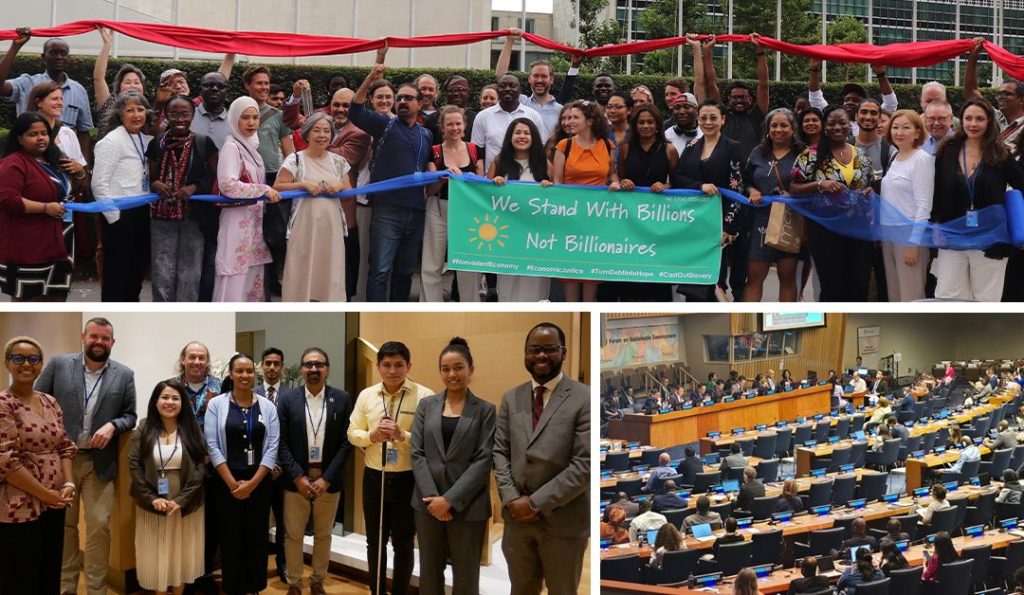
The 10th High-Level Political Forum (HLPF), held from July 13–24, 2025, at UN Headquarters in New York, marked a critical checkpoint since the adoption of the 2030 Agenda for Sustainable Development. As the UN’s central platform for reviewing the Sustainable Development Goals (SDGs), the HLPF brought together governments, UN agencies and civil society to assess progress, share lessons and influence policy directions at the highest level. Recognizing that civil society voices are essential to driving meaningful SDG progress, Cooperation Canada played a key role in amplifying those perspectives by supporting the participation of Zia ur Rehman, representing the Asia Development Alliance (ADA), at the forum.
SDG Concerns at the HLPF Empty heading
This year’s HLPF took place against a backdrop of growing concerns. The Fourth Financing for Development Conference (FfD4) concluded with civil society underfunded and expectations for meaningful SDG progress reduced. The launch of the XDG 2045 Global Survey by the UAE also stirred mixed reactions. While intended as a global consultation for post-2030 priorities, its timing—when only five years remain for the SDGs—was seen by many as premature and distracting from urgent acceleration efforts.
According to the UN Secretary-General’s SDG Progress Report 2025, only 35% of SDG targets are on track, and a mere 17% are projected to be achieved by 2030, with Asia’s progress even slower. Having already fallen short on the Millennium Development Goals and Sustainable Development Goals (MDGs) in 2015, the world is now failing to meet the SDGs—a collapse of Agenda 2030 would be a severe blow to multilateralism and global governance.
ADA’s Participation Empty heading
Asia Development Alliance (ADA) is a leading regional platform promoting localization, inclusive democracy, an enabling civic environment and financing for sustainable development and climate action. ADA contributed to the HLPF through civil society statements, alternative reports and five high-impact side events as lead or co-organizer with various national and global partners.
This year, ten Asian countries presented their Voluntary National Reviews (VNRs): Japan, Thailand, Malaysia, Indonesia, Philippines, Bangladesh, Bhutan, India, Kazakhstan and Kyrgyzstan. The Asian VNRs showcased promising initiatives, including Japan’s SDGs curriculum integration, Indonesia’s 60,000 SDG Villages, Malaysia’s constituency-level SDG monitoring, Kazakhstan’s online SDG education platforms and both the Philippines’ and Bangladesh’s People’s own Voluntary Local Reviews (VLRs).
Civil Society at the Forum Empty heading
Civil society statements flagged critical gaps: lack of human rights-based approaches, insufficient financing, shrinking civic space, weak monitoring and data systems, poor coherence between UN bodies and governments and exclusion of CSOs from decision-making. Their call-to-action centred on localizing the SDGs and supporting civil society-led VLRs, expanding youth-centered and intergenerational governance, institutionalizing CSO participation in UN platforms and investing in inclusive data systems and feminist budgeting. The message was clear: without urgent, coordinated and adequately financed action, the world risks repeating the missed opportunities of the MDGs—only this time with far greater consequences for people and the planet.
Civil society participation is critical to ensuring that the voices of communities, particularly those from the Global South, are heard and reflected in global decision-making. By supporting ADA’s presence at the HLPF, Cooperation Canada aimed to strengthen civil society’s collective advocacy, ensure more inclusive dialogue and contribute to more equitable and representative policy outcomes.
— Zia ur Rehman, Secretary General / Director, Asia Development Alliance